Guide
Playing blockchain games on Cronos
Cronos is an EVM-compatible blockchain backed by Crypto.com, with fast blocks and low gas fees, which makes it a practical home for games rather than just trading. Playing a game on Cronos needs three things: a wallet like MetaMask configured for the Cronos network, a little CRO (the native token) for transactions, and a browser. In a well-built web3 game on Cronos your characters and items are ERC-721 tokens in your own wallet: the game renders them, but you own them, trade them and keep them even if you stop playing. Cromon Quest, a creature-collection RPG with 120 Cromons across 10 elemental types, is a working example of the model, and starting it costs nothing.
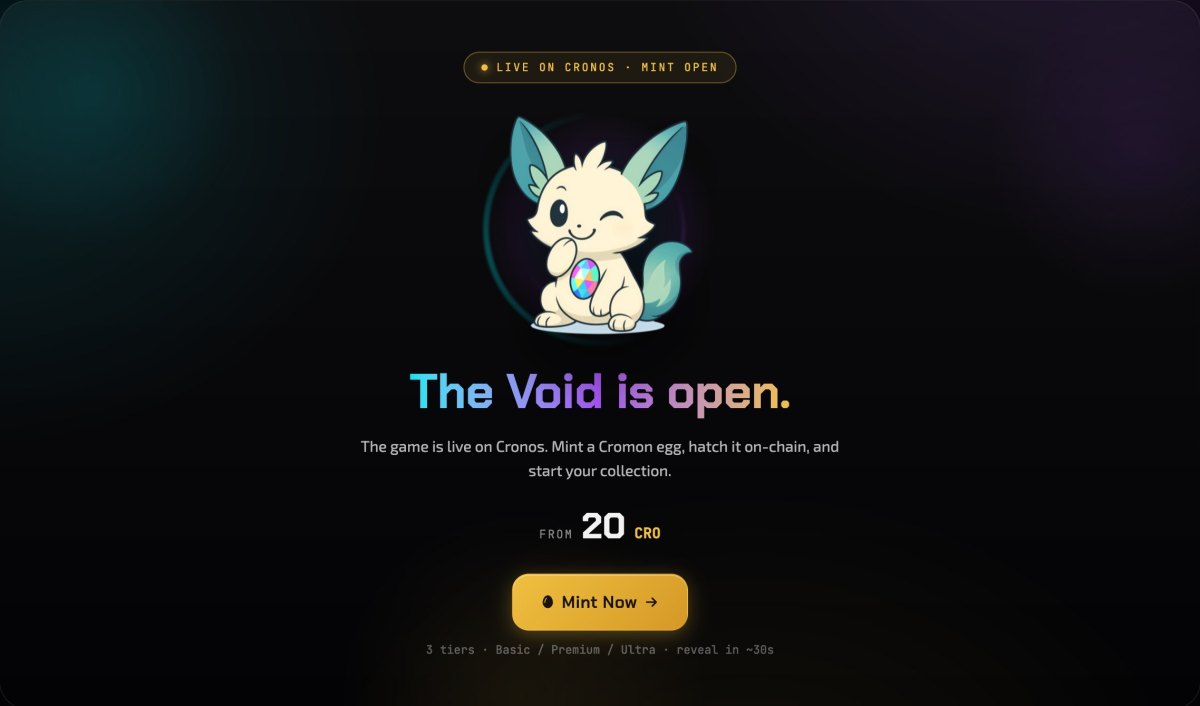
What is Cronos, in practice?
An Ethereum-compatible chain: the same wallets, the same token standards, but with much lower fees, so game actions like minting, trading and fusing stay cheap. Blocks land in seconds, which makes on-chain game actions feel quick. CRO is the native token, used for gas and for in-game purchases, and the GameFi side of the ecosystem is built on exactly that combination.
What does a game NFT actually give you?
Ownership that outlives the game client. When a creature or item is an ERC-721 token in your wallet, the game cannot take it back, you can sell it on a compatible marketplace, and its history is public. In Cromon Quest every Cromon you mint works this way (the three free starters are in-game creatures, not NFTs): even the Fusion Forge, which burns three creatures to mint a stronger one, is a transaction you sign yourself.
How do I get set up?
Install MetaMask or any WalletConnect wallet, add the Cronos network (games usually offer it in one click), and fund it with CRO from Crypto.com or another exchange if you plan to buy anything. Connecting to a game is a signature, not a payment: starting Cromon Quest, for instance, is free and grants three starter Cromons.
What should I look for before playing?
Three honest signals:
- Published odds. If a game sells randomized mints, the percentages should be public and enforced on-chain, the way Cromon Quest's Rift tiers are.
- Real gameplay you can try before spending. Browser access and a free entry point beat a whitepaper: try the Arena or a server-wide raid first.
- Provable fairness on random outcomes. Commit-reveal schemes mean results cannot be manipulated, by anyone.
What does Cromon Quest actually put on-chain?
Only what ownership needs. The Cromon collection is one ERC-721 contract on Cronos mainnet (chain id 25), verified on the Cronos block explorer. Three acts go through it: a mint, where a commit-reveal scheme locks the outcome before anyone can read it and the stats are written to the token; a fusion, which burns three tokens and mints one; and a marketplace trade, held in escrow by the contract with a 5% buyer fee, no seller commission and a 2% penalty on a listing cancelled within 72 hours. Everything that changes every minute stays off-chain on purpose: Shards, CroCoin, Aether, XP, Cromite boosts and fight results live in the game's ledger, so playing never costs gas and never waits for a block.
Which wallets work, and do I need one to try?
Any wallet that speaks WalletConnect, which is more than a hundred, plus MetaMask and Trust Wallet directly. If you have none, the connect window creates one for you from an email address or a Google, X, Discord or GitHub login, so the first session needs no extension and no seed phrase. Connecting is a signature, never a transaction, and the three starter Cromons are in-game creatures granted on that signature, so trying the game costs nothing. CRO enters the picture on the day you mint, fuse or buy: fund the wallet from Crypto.com or any exchange that lists CRO, and keep a little extra for gas. The game itself runs on mainnet; a separate testnet build (chain id 338) is where features are tried before they ship.
Try it on a real game
Free to start: connect your wallet, receive three starter Cromons and see what on-chain ownership feels like.