Guide
Cromon Quest vs other NFT games
Most NFT games share one shape: buy first, play a single loop around the collection, and hope the token holds. Cromon Quest, a creature-collection RPG on Cronos, is built the other way round. Entry is free, three starter Cromons open every mode on a signature, and CRO only appears when you choose to mint, fuse, trade or top up CroCoin. The in-game economy of Shards, CroCoin and Aether lives off-chain, so play never costs gas and nothing pretends to be money. Randomness is enforced by the contract through commit-reveal, rarity buys flexibility rather than raw power, and Keepers vote on the roadmap in a Council. This page lays those differences out against the usual pattern, criterion by criterion, without naming any other game: the comparison is with a shape, and you can hold any title up to it.
How does it compare, criterion by criterion?
| Criterion | The usual NFT game | Cromon Quest |
|---|---|---|
| Entry | A mint or a token purchase before the first session. | Three starter Cromons on a free signature; every mode open from minute one. |
| Randomness | Server-side rolls, or odds stated in a document. | Rift odds and stat bands in the contract, drawn by commit-reveal from a future block. |
| Ownership | Creatures as database rows, or NFTs the game can freeze. | One verified ERC-721 contract on Cronos mainnet; tokens live in your wallet. |
| Economy | A token that has to hold a price for the game to work. | Shards and CroCoin are in-game only, with no cash value and nothing to cash out; CRO enters only to mint, fuse, trade or top up CroCoin. |
| Gas | A transaction per action, or a custodial wallet to hide it. | Four on-chain acts in total, mint, fusion, trade and an optional CroCoin pack; every fight, mine claim and expedition is free of gas. |
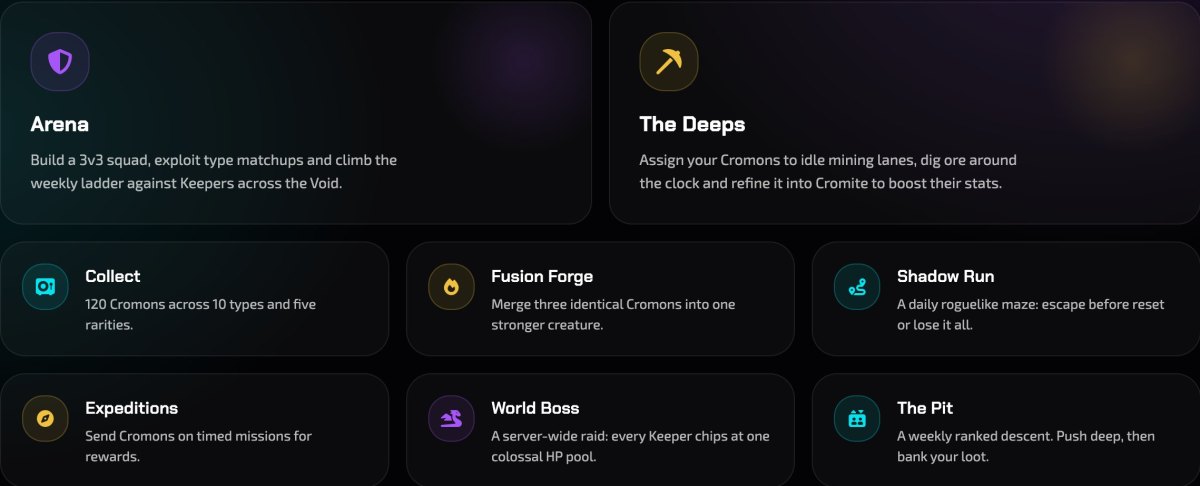
| Play | One loop, usually a battle, around the collection. | 15 interlocking modes and systems on one collection. |
| Fairness | Rarity as raw power. | Rarity sets technique slots and Cromite drop odds; stats are rolled per token inside the Rift band, so a Common can out-fight a Legendary. |
| Governance | A roadmap decided elsewhere. | A Council: one vote per Cromon owned, 70% to pass, and a public changelog. |
Why does "free to start" matter more than it sounds?
Because it changes who the game is built for. A game that needs a purchase before the first fight has to sell you on a promise; a game you can play first has to be good. Cromon Quest's starters, Kindlekin, Pladdle and Sproutara, carry 8 on every stat, enough for the early Arena, a mine lane and a Common expedition, and the day you want more, a Basic Rift costs 20 CRO. Nothing on the way there asks for a wallet extension either: the connect window creates a wallet from an email or a social login.
Why keep the economy off-chain?
Two reasons, and both are the opposite of the usual design. The first is cost: a mine claim, an Arena attack or a daily quest reward would each be a transaction if Shards were a token, and nobody plays a game that asks for a signature every minute. The second is honesty: an in-game currency that can be cashed out has to hold a price, and the game bends around that price. Shards and CroCoin cannot be withdrawn; they are spent on the nine Camp buildings, Dojo capsules and training, and shop boosts. What has value outside the game is exactly what is on-chain: the Cromons themselves, tradeable on the marketplace with a 5% buyer fee and no seller commission.
Why is rarity not raw power?
In many collections a Legendary is a Common with bigger numbers. In Cromon Quest the numbers come from the Rift, not the rarity: a Basic Rift rolls every stat between 3 and 24, an Ultra Rift between 20 and 30, whatever comes out. Rarity buys flexibility: a Common can know 2 Dojo techniques, a Legendary 5, every technique reaches rank 3 for both, and a rarer Cromon earns the rarity charter of a Rare, Epic or Legendary expedition (+3% to +8%). Then two paths raise any Cromon: Cromite from The Deeps, up to +10 per stat, and fusion at the Forge. A mined, fused Common team beats an idle Legendary.
Where does Cromon Quest not try to compete?
Three honest limits. It is browser-only, with no native app, though it installs to a phone's home screen. Its weekly shared maze is in open beta, and its exit credits nothing to your account until the beta ends. And it does not promise income: the only thing you can sell is a Cromon, to another Keeper, at the price its seller set. If what you want is a token with a chart, this is the wrong game. If what you want is a creature RPG whose collection happens to be yours, the comparison above is the case for it.
Compare it by playing it
Free to start: connect a wallet or an email, receive three starter Cromons and put the comparison to the test.