Guide
Cromon Quest beginner guide: everything in one page
Cromon Quest is a creature-collection RPG on the Cronos blockchain that plays in your browser. You are a Keeper: you collect Cromons, 120 species across 10 elemental types and 5 rarities, and you send them into 15 modes and systems, from 3v3 Arena battles and a server-wide World Boss to idle expeditions, a daily roguelike maze, seven elemental mines and a weekly ranked descent. Minted Cromons are ERC-721 tokens in your wallet; everything else, Shards, CroCoin, Aether, XP and Cromite, lives in the game. Starting costs nothing: connecting a wallet (or an email, which creates one) grants three starter Cromons that can play every mode. This guide walks through all of it, in the order a new Keeper meets it, with the real numbers from the game's configuration.
What do I need to start?
A browser and a way to sign. The connect window accepts MetaMask, Trust Wallet and any WalletConnect wallet, and if you have none it creates one from an email address or a Google, X, Discord or GitHub login. Connecting is a signature, not a transaction, so it costs nothing and moves nothing. You then pick a Keeper name, accept the terms, and three starter Cromons are granted: Kindlekin (Fire), Pladdle (Aqua) and Sproutara (Grass). They are in-game creatures rather than NFTs, every stat sits at 8 on the 30-point scale, and they cannot be traded or fused, but they can fight, dig, explore and go on missions from the first minute. CRO, the Cronos token, only matters on the day you decide to mint, fuse, buy a Cromon or top up CroCoin.
What are Cromons, and what makes one strong?
A Cromon is a creature of the Crystal Void with a species, an element and a rarity, plus eight stats written on-chain when it is minted: six visible ones, HP, Attack, Defense, Speed, Critical and Resolve, and two reserved for later mechanics, each on a 30-point scale. The catalog holds 120 species: 36 Common, 36 Uncommon, 28 Rare, 13 Epic and 7 Legendary, spread over the 10 types Fire, Aqua, Grass, Wind, Electric, Rock, Fight, Shadow, Light and Crystal. Two things make an individual Cromon strong. Its rolled stats, summarised by a perfection score that divides the six visible stats by the 180 maximum. And what you add afterwards: Cromite from The Deeps, up to +10 per stat, and fusion, which merges three copies of a species into one with 6 more visible points. Rarity does not change the stat band a Rift rolls; it sets how many Dojo techniques the Cromon can learn, from 2 for a Common to 5 for a Legendary, how often expeditions drop Cromite for it, and which expedition charters it earns.
How does the type chart work?
Ten elements, one 10 by 10 chart. When the attacking element beats the defending one the hit is multiplied by 1.5; when it loses, by 0.75; most pairings are neutral. Every element beats exactly two others and loses to exactly two, so no single type is safe and none is quietly stronger than the rest: Grass beats Aqua and Electric but loses to Fire and Wind; Rock beats Fire and Wind but loses to Aqua and Fight. The starter trio already covers three elements, which is the point: a mixed team always has one favourable pairing to play. The full chart is on the types and rarities guide and in the Matchup tab of the Arena.
Which modes are there, and in what order should I try them?
All of them are open from day one. This is the order in which they pay off for a new roster:
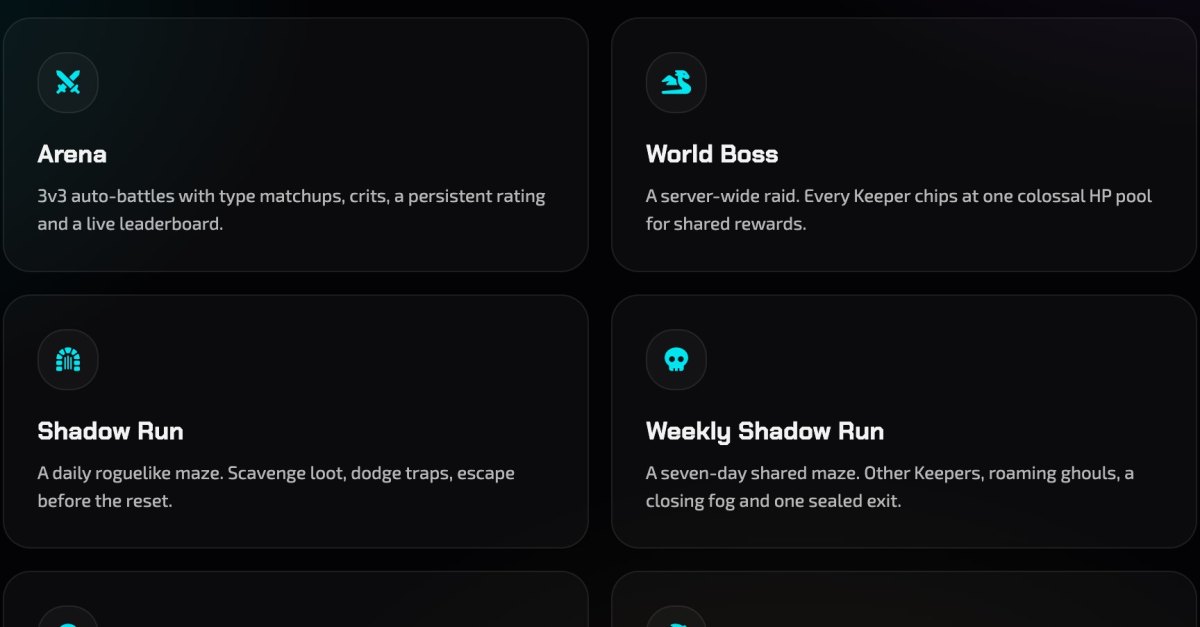
- Arena: 3v3 auto-battles against other Keepers' defense teams, 1 Aether per attack, an Elo-style rating that never resets. Fight one early to learn the rhythm.
- Expeditions: send 1 to 3 Cromons on a timed mission from 1 to 24 hours and collect Shards and CroCoin. The 1-hour Common run costs no Aether.
- The Deeps: idle mining across seven elemental mines. Lane 1 of Fire Gorge is free, the mine keeps digging while you are away, and progress pays Cromite.
- Shadow Run: one roguelike maze run a day. The door you enter by is the only way out, sealed: four Sigils unseal your haul, a share at a time.
- World Boss: when a boss is live, the whole server chips at one HP pool with free raid energy, 3 attacks held, one back every 6 hours.
- Camp and Dojo: where Shards go. Nine buildings that widen every other mode, and a training hall for the six formation techniques.
- The Pit, Weekly Mine and Weekly Shadow Run: the weekly rhythm, for a roster deep enough to lock a crew for days.
- Minting, Fusion Forge and Marketplace: the three on-chain acts, for when you want to grow past the starters.
The Council sits above all of it: Keepers vote on what gets built next, one vote per Cromon owned, 70% to pass.
How does an Arena fight actually resolve?
You pick three free Cromons, the game draws a defense team within 2 ranks of yours (widening up to 20 when the neighbours are on cooldown), and the fight plays itself out on a 3 by 3 grid for up to 30 rounds. Each hit starts from the attacker's Attack squared over Attack plus the defender's Defense, jittered by 8%, then takes the type multiplier. Four rolls sit on top: a critical hit doubles the damage with a chance of Critical divided by 100 (capped at 30%), a block from Defense plus Resolve over 400 lets only 40% through, a dodge from Speed over 200 lets nothing through, and a fumble, never below 2%, recoils a quarter of the damage onto the attacker. HP is 80 plus 4 per point of the HP stat. Wins pay 9 to 12 XP and raise your rating; losses still pay 7 Shards and 2 to 4 XP but cost the Aether and some rating. Your Cromons are never at risk in any fight.
How do the idle loops pay?
Expeditions come in five tiers, and the payout climbs far faster than the timer: a Common hour pays 10 to 16 Shards, a Legendary day 350 to 500 Shards and 25 to 45 CroCoin for a team of three and 3 Aether. Three offers roll every day from a pool weighted by your expedition rank, the board refreshes once a day for free and then for 1, 2, 4 and 8 CroCoin, matching the mission's element adds 5%, meeting its stat bar on every Cromon sent another 5%, and on Rare, Epic and Legendary runs one Cromon of that rarity or better adds 3%, 5% or 8%. The Deeps is the other engine: Cromons dig in lanes, a mine keeps digging at half speed for up to 6 hours while you are away, ore buys deeper lanes and building levels, and the prize is Cromite, a permanent +1 to one stat, up to +10. A Cromon on a mission or a lane is busy until it returns, so the size of your roster sets how many loops run at once; the Camp's Expedition Hall raises the parallel expeditions from one to four.
What are the currencies, and what do they buy?
- Shards and CroCoin: the two in-game currencies, paid by almost every mode (The Deeps pays Cromite instead) and spent in the Camp, the Dojo and the shop. They live in the game's ledger, not on-chain, and cannot be withdrawn: they are what you build with.
- Aether: the shared energy, capped at 10 with one point back per hour, one per Arena attack; raids, the Pit and the maze have their own pools. The Camp's Aether Reactor and Conduit shorten the refill and raise the cap.
- Cromite: crystallised essence, typed or neutral, that raises one stat permanently. The first three points of a stat cost one Cromite each, later points more, and neutral Cromite costs twice the typed price.
- Pit Embers: the Pit's own resource, part of the price of the upper levels of the three Pit buildings.
- Shadow, Light and Pearl orbs: maze loot; the daily drops Shadow and Light orbs, the weekly hides Pearl Orbs in its deepest zones.
- CRO: the only on-chain money. Rifts cost 20, 50 or 150 CRO, a fusion 10 CRO, and marketplace prices are set by sellers.
The main Shard sinks are the Camp's nine buildings, the Dojo capsules (1,500, 3,000 and 6,000 Shards for a draft of 1, 2 or 3 techniques) and training (3,000 Shards to rank 2, 8,000 to rank 3), and the shop's 24-hour stat boosts. CroCoin buys the premium boosts, expedition refreshes and daily quest rerolls.
How does progression work?
Everything that awards XP feeds one Keeper level, up to level 50; grindable sources are capped at 1,500 XP a day, milestone XP (World Boss and Weekly Mine tiers, achievements, the Robin chest) is not. Arena wins pay 9 to 12, losses 2 to 4; a won Pit wave pays 30 plus 10 per floor; World Boss tiers pay 200, 500 and 1,500 at three milestones; the maze and the Weekly Mine feed the same curve, while expeditions and The Deeps pay no XP at all. Your level sets your expedition rank, which is what the offer pool reads: Rookie to level 5, Keeper 6 to 15, Tamer 16 to 25, Explorer 26 to 35, Vanguard 36 to 45, Chainmaster 46 to 50, and a Chainmaster sees 13% Legendary offers where a Rookie sees 1%. Three daily quests roll every morning, and completing all three pays a bundle of 150 Shards and 8 CroCoin, times 1.25 on a 7-day streak and 1.5 from 30 days (a quest reroll costs 5 CroCoin); the referral program pays 200 Shards and 20 CroCoin to a recruit at the link, then 800 Shards, 80 CroCoin and a free mint to the referrer once the recruit has minted three Cromons from paid Rifts.
When should I mint, and which Rift?
When the starters stop being enough, which for most Keepers is the first time a mine lane or an expedition asks for a stat bar they cannot meet. A Rift is opened on-chain with a commit-reveal scheme: your transaction locks the outcome, the reveal lands a few blocks later, and nobody can peek or re-roll. Three tiers set the odds and the stat band, and the same numbers are enforced by the contract:
| Rift | Price | Stat band | Rare | Epic | Legendary |
|---|---|---|---|---|---|
| Basic Rift | 20 CRO | 3 to 24 | 14% | 3.5% | 0.5% |
| Premium Rift | 50 CRO | 13 to 28 | 25% | 12.5% | 2.5% |
| Ultra Rift | 150 CRO | 20 to 30 | 35% | 20% | 10% |
A Basic Rift is the cheap way to fill the 120-species CromonScan and to farm fusion duplicates; a Premium Rift guarantees a floor of 13 per stat, a fighter you can field at once; an Ultra Rift is the collector's roll, with a 10% Legendary chance and a floor of 20. Up to 10 Cromons open in one transaction. The minting guide walks through the flow.
What are fusion and the marketplace for?
Fusion is how a Cromon gets stronger on-chain after the mint. Three copies of the same species and rarity go into the Forge; all three are burned and a new token is minted with the base copy's stats plus 6 points placed on its lowest visible stats and 1 on each reserved stat, every stat capped at 30. The fee is 10 CRO, the base's Cromite levels carry over and the fuels' Cromite comes back as a budget, so nothing mined is lost. The marketplace is the other way to a specific Cromon: an on-chain escrow with a 5% buyer fee, no seller commission and a 2% penalty on a listing cancelled within 72 hours, where the stats of what you buy are readable before you pay. Starters cannot be listed; a listed Cromon leaves your Vault until the sale or the cancellation.
What does the weekly rhythm look like?
Three things run on a weekly clock. The Pit opens every other Monday at 00:00 UTC and stays open seven days (the fortnight calendar started on 7 September 2026): two descents per Pit at 2 Aether each, a crew of 3 to 20 Cromons locked until you bank, depth milestones paid once per Pit down to floor 55, one board ranked on the deepest floor banked whose top 3 win a free mint (Ultra, Ultra, Premium), and a draw of 3 Premium free mints among the tickets earned on floors 10, 20, 30, 40 and 50. The Weekly Mine is a seven-day themed race opened by the team on The Deeps, with personal score tiers for everyone and a podium with titles. And the Weekly Shadow Run opens a shared 125 by 125 maze for seven days, with other Keepers in the corridors, roaming ghouls, a fog that closes ring by ring and one sealed exit; it is in open beta, so its exit credits nothing to your account yet. World Boss events sit outside that cadence: a boss spawns for several days, usually five, and every Keeper who fought banks the community tiers the server crossed. None of these needs a big roster to enter, but all of them reward one: a Pit crew and a mine full of miners cannot be the same Cromons.
Which mistakes cost new Keepers the most?
- Stacking one element. A trio of one type shares one weakness; cover two or three types.
- Leaving the defense team unset or weak (an unset one is filled with three random Cromons). It fights while you sleep and every loss it takes costs rating.
- Boosting the two copies you plan to feed the Forge. Only the base's boost levels carry; the fuels' Cromite is refunded, not multiplied.
- Pushing a Shadow Run one room too far. Nothing is yours until the door; a knockout costs half the haul even with the Second Wind.
- Locking every Cromon at once. A Pit crew, a mine lane and an expedition all make a Cromon unavailable to the Arena.
- Sending a starter into a fight it cannot win and calling the game hard. Starters are 8 on every stat by design; the first Rift is the step up.
Where do I go from here?
For the team game, the Arena team guide, the tier list and the Dojo and techniques guide. For the economy, rewards in Cromon Quest and the Aether and energy guide. For the on-chain side, how to buy and sell Cromons and the fusion guide. For the weekly modes, the Weekly Shadow Run survival guide and the Pit descent strategy. And when a word on this page is new, the glossary has it. The mascot, Cromy, is species number 74 in case you were wondering.
Start with three, build from there
Free to start: connect a wallet or an email, receive three starter Cromons, and everything on this page opens up.