Guide
Cronos NFT games: what to look for before you play
Cronos, the EVM chain backed by Crypto.com, has the two things an NFT game needs: cheap transactions and the same wallets and token standards as Ethereum. What separates a game from a token with a website is a short list you can check in ten minutes: whether you can play before buying, whether random outcomes have published odds enforced on-chain, whether the creatures are ERC-721 tokens you hold yourself, and whether day-to-day play stays off-chain so it never costs gas. Cromon Quest, a creature-collection RPG with 120 species across 10 elemental types, is the worked example on this page: free to start with three starter Cromons, Rifts from 20 CRO with odds written into the contract, and an in-game economy of Shards and CroCoin that lives in the game's ledger, never on the chain.
Can I play before I buy anything?
The first filter, and the one most projects fail. A game that asks for a mint before it shows you a fight is asking you to buy a whitepaper. On Cromon Quest the connect window creates a wallet from an email if you have none, signing in is a signature rather than a transaction, and three starter Cromons are granted at once: Kindlekin, Pladdle and Sproutara, every stat at 8 on a 30-point scale. They are in-game creatures, not NFTs, and they can enter every mode: the Arena, a 1-hour expedition, a mine lane, the daily maze. You will know whether the game is for you before CRO is ever mentioned.
Are the odds published and enforced on-chain?
Any randomised mint should show its percentages, and the contract, not the server, should enforce them. Cromon Quest's three Rift tiers publish their rarity odds and stat bands on the mint page and the same table lives in the contract: a Basic Rift at 20 CRO rolls 0.5% Legendary and stats between 3 and 24, an Ultra Rift at 150 CRO rolls 10% Legendary and stats between 20 and 30. The draw itself uses a commit-reveal scheme: your transaction locks the mint, the outcome is derived from a block that does not exist yet, and the reveal lands a few blocks later, so neither a player nor the team can peek or re-roll. That is the difference between "provably random" and "trust us".
Do I really own the creature, and what does the game keep?
Ownership means an ERC-721 token in a wallet you control, on a verified contract, that the game cannot claw back. Cromon Quest's collection is one contract on Cronos mainnet (chain id 25), verified on the block explorer; a minted Cromon sits in your wallet, its eight stats written at the reveal, and it stays yours if you stop playing. The honest counterpart is what the game keeps off-chain on purpose: Shards, CroCoin, Aether, XP, Cromite boosts and fight results live in the game's ledger. That is not a weakness. It is why a fight, a mine claim or an expedition never costs gas and never waits for a block, and it is why those balances have no cash value: they are what you build with, not what you cash out. Only three acts touch the collection contract: minting, fusing three copies into a new token, and trading on the marketplace; the one other on-chain purchase is a CroCoin pack, bought for CRO from a separate store contract.
Is there a game underneath, or just a marketplace?
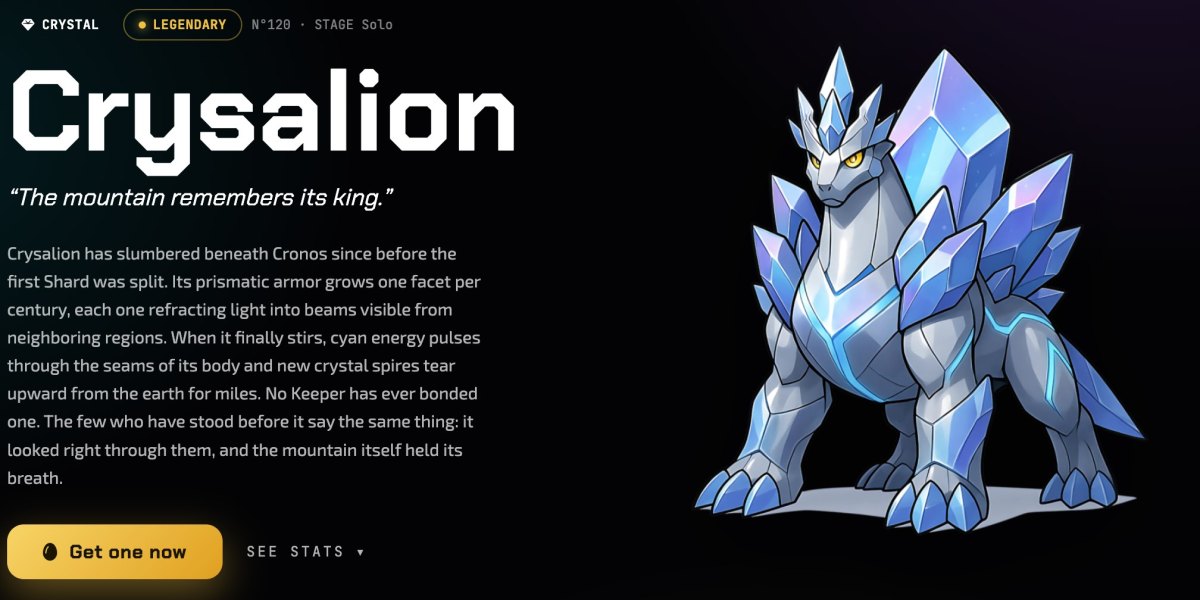
Count the loops and check whether they interlock. Cromon Quest runs 15 modes and systems on one collection: 3v3 auto-battles with a 10 by 10 type chart, a server-wide World Boss raid, timed expeditions, seven idle mines that pay permanent stat boosts, a daily roguelike maze and a weekly shared one, a weekly ranked descent, a Dojo of six formation techniques, nine Camp buildings and a Council where Keepers vote on the roadmap with one vote per Cromon owned. The interlock is the tell: Cromite mined in The Deeps changes Arena fights, expedition Shards pay for Camp buildings that add expedition slots and Aether, and mine ore buys the deeper lanes, and a Legendary like Crysalion is valued for the five techniques its rarity allows, not for a sticker.
What does trading look like on Cronos?
The chain makes it cheap; the game decides whether it is fair. Look for an escrow contract rather than a trusted middleman, a fee you can read, and information about what you are buying. Cromon Quest's marketplace holds the listed token in the contract's escrow, charges a 5% buyer fee on top of the price and no seller commission, applies a 2% penalty only to a listing cancelled within 72 hours, and shows every listing's stats and perfection score before you pay. Prices are in CRO and set by sellers. The three starters cannot be listed, so everything on the market is something a Keeper chose to mint.
The ten-minute checklist
- Free entry with real gameplay, not a demo video.
- Published mint odds, enforced by the contract, with a commit-reveal or equivalent.
- A verified ERC-721 contract on Cronos mainnet, tokens in your own wallet.
- A clear line between what is on-chain (ownership) and what is not (play), and no promise that in-game currency is money.
- An escrow marketplace with a readable fee.
- A public changelog and some form of player governance.
Cromon Quest passes all six, and this site documents each one so you can check rather than believe: the safety guide for custody and signatures, the Council for governance, the changelog for the release history.
Judge it by playing it
Free to start: connect a wallet or an email, receive three starter Cromons and try every mode before spending a single CRO.